From Job Postings to Measurable Tasks
Building a Task Extractor to track how work is changing in Singapore

In brief. The Task Extractor converts unstructured text from job postings into consistent, structured task data. This gives us a more precise view of the work performed within job roles, strengthening how we assess AI’s impact, support job redesign, and prepare workers and employers for the changing nature of work.
The National Jobs-Skills Data Office (NJSDO), within the Skills and Workforce Development Agency (SWDA), builds the agencies’ data infrastructure and intelligence layer for jobs-skills-tasks monitoring and analytics. Much of that work involves turning unstructured text, mostly job descriptions from digital job postings, into signals that can be counted, tracked and compared.
Two signals are already in production. The Job Role Extractor identifies Skills Framework-aligned job-role titles. The Skills Extraction Algorithm, or SEA, identifies the skills associated with the work as articulated in the Skills Framework (SFw) which serves as the common jobs-skills language. Together, these capabilities enable us to monitor how demand for jobs and skills is evolving across Singapore’s labour market.
With the rise of generative AI, we saw an opportunity to extend this foundation. Understanding job roles and skills remains essential, but a closer view of the work performed within each role can provide an additional layer to analyse, understand, and pre-empt changes to skills and training requirements.
The current SFw task data remains largely unstructured, limiting our ability to perform meaningful analysis. That said, SWDA has an extensive database of key tasks across each of the 39 sectoral Skills Frameworks that we have developed with our sector agencies, which gives us a rich repository to identify similarities and linkages. By exploring how we could (i) retrieve tasks from both labour-market information and expert inputs, and (ii) create a structured representation of task information, we could open up a new dimension of job–task–skill intelligence.
From job roles and skills to tasks
Ask two software engineers what they do, and you may get two completely different answers. One might design REST APIs, optimise database queries and respond to incidents across distributed services. Another might build React component libraries, improve accessibility and mentor engineers on design systems.
Job titles match, but their work does not.
This distinction matters when we try to understand how artificial intelligence (AI) is changing job constructs. Jobs rarely disappear or transform overnight. Instead, their context shifts at the task layer: some activities are automated, some are done differently with the involvement of AI and others become more important to retain the human element because they depend on judgement, communication or oversight.
Tasks form the nexus between job roles and skills, connecting what a role involves with the capabilities needed to perform it. Job roles are bundles of tasks. Workers apply skills to complete those tasks. AI tools, in turn, act on particular tasks rather than on a job title in the abstract. If we want to measure change with enough precision to guide workforce decisions, the task is a practical place to start.
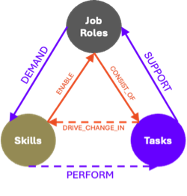
Tasks connect jobs and skills that were previously often studied separately. A job role gives tasks an organisational home. Skills describe the capabilities that let a worker perform those tasks. Tasks provide the observable layer in between: the actual units of work that employers ask people to complete.
The relationships also run in both directions. A changing mix of tasks alters the content of a role and the skills it demands. At the same time, workforce skills influence which tasks can be performed, combined or redesigned. Tracking tasks therefore gives us a practical way to see job and skill changes forming, before a job role and its title fundamentally change.
Our first foray: Analysis of AI impact on tasks
SWDA’s first foray into task-level analysis was to better understand AI’s impact. We started with the SFw, a localised taxonomy of job roles, skills and tasks created with industry experts and sector agencies. It contains about 37,000 task statements across 38 sectors and covers roughly 80% of Singapore's workforce. This gave us a credible local reference dataset for a first assessment of AI's potential effect on work.
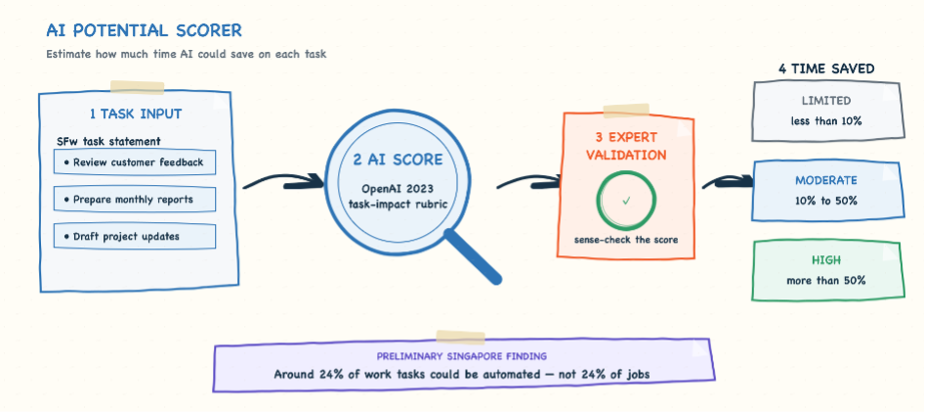
We ran an AI Potential Scorer on the SFw tasks. The scorer applies OpenAI's 2023 task-impact rubrics through an LLM classifier with expert validation. It estimates the time that large language models could save on a task and groups the task into three buckets:
1. Limited impact at less than 10 per cent time savings
2. Moderate impact at 10 to 50 per cent
3. High impact at more than 50 per cent.
The initial analysis suggested that about 24%, or close to a quarter of tasks in SFw, can be aided by the application of AI, either with existing generic tools, or with some level of workflow and software customisation. The analysis results gave us an early indication of the scale of possible change, but it did not mean that 24% of jobs would disappear. Jobs combine tasks with different levels of exposure, including work that still depends heavily on decision making, critical thinking and communication.
This task-level view of AI’s impact can guide more targeted responses. It can help identify occupations with a high concentration of exposed tasks, and direct training investment towards skills that remain important when AI tools enter a workflow. It also provides evidence for updating curricula by education and training providers, and for enterprises to redesign jobs while retaining appropriate human oversight.
Why the next analysis needed labour market tasks
The analysis of AI’s impact on SFw tasks provided a strong starting point, but a curated framework cannot capture every change in employers' requirements. While SFw provides a stable reference for the baseline tasks associated with each job role, labour-market data offers a more current view of how employers describe work and emerging responsibilities
Skills Framework provides a starting base. Labour-market data reveals the movement.
We therefore complemented SFw tasks with those mined directly from job postings. This lets us observe how employers describe current responsibilities, detect new combinations of work, and compare changing demand over time with the baseline tasks. More detailed task data could also further improve AI-impact analysis, by giving the scorer a broader and more current view of work.
That goal created a technical problem. A job description is not a clean list of tasks. It mixes responsibilities with company descriptions, qualifications and experience requirements, and promotional language about the job. Genuine tasks may be packed together in a long sentence or expressed differently by different employers. Before we could analyse these signals, we had to make the tasks explicit and consistent. This became the premise for the Task Extractor.
Building the Task Extractor
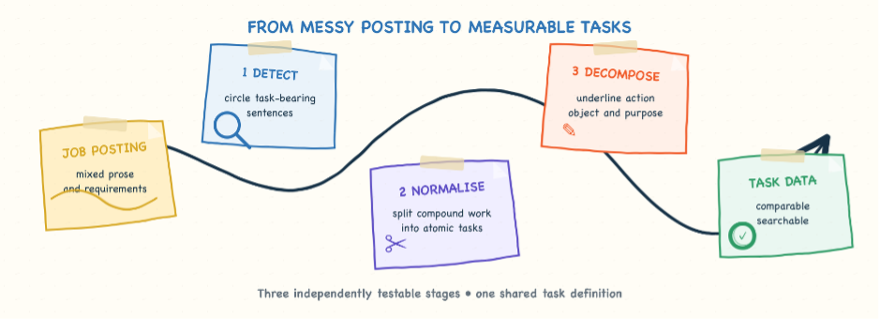
At a high level, the extractor acts as a bridge between two very different forms of information. The input is free text written for recruitment: varied in tone, granularity and structure. The output consists of consistent task records that can be counted, grouped, compared and linked to other jobs-skills data.
Figure 3 makes the internal hand-offs explicit. The pipeline first decides which sentences actually describe work, then rewrites compounded or context-heavy sentences into atomic tasks, and finally decomposes each task into defined fields. Each stage produces an intermediate output that can be inspected and evaluated, rather than relying on one opaque end-to-end decision.
First, define what counts as a task
The most consequential choice was not model architecture. It was a policy decision: what, exactly, should the system recognise as a task?
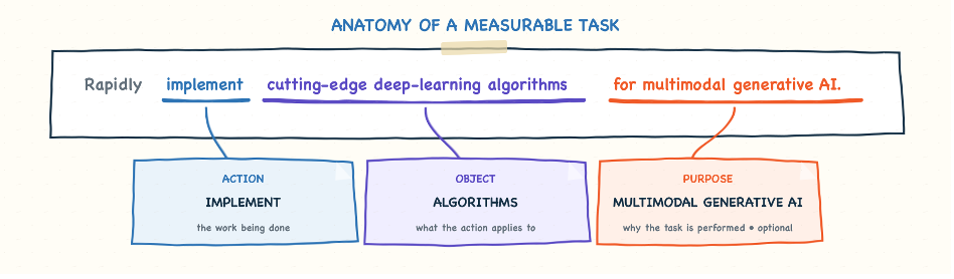
A measurable task is one which contains an action + an object + an optional purpose.
Consider the statement:
“Rapidly implement cutting-edge deep-learning algorithms for multimodal generative AI.”
The action is “implement”, the object is “cutting-edge deep-learning algorithms”, and the purpose is “for multimodal generative AI”.
By contrast, “Experience in the latest multimodal technologies” describes a requirement, not a task: it does not state a piece of work to be performed.
This structure gives the extractor a consistent unit of analysis. It also makes later comparisons more meaningful. We can compare actions with actions, objects with objects, purposes with purposes, and the relationships among actions, objects and purposes; instead of relying only on surface-level sentence similarity.
The extraction pipeline
The Task Extractor processes unstructured job-posting text in three stages. Each stage solves a narrower problem, which makes the overall pipeline easier to reason about and evaluate.
Stage 1: Identify sentences that contain tasks
The pipeline first cleans the job posting and splits it into sentences. It then creates a sentence embedding and passes that representation to a logistic-regression classifier head. The classifier separates likely task sentences from other content, such as role introductions or experience requirements.
As illustrated in Figure 4 a job posting might combine team context, evaluating operational programmes, implementing efficiency strategies and an experience requirement. The task content sits in the middle; the opening is context and the closing is a qualifier.
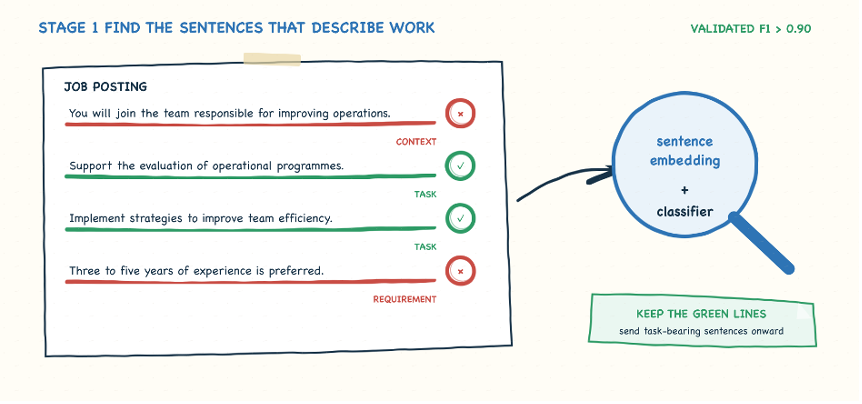
Sentence-level classification provides a cheaper way to isolate the work needed to be performed. It reduces a long posting to sentences worth processing further. This keeps irrelevant information such as job role introductions, hiring criteria, etc. from entering the task dataset, while preserving task-bearing sentences that may contain one or several components of work.
In validation with SWDA job-skills analysts the sentence classifier achieved an F1 score above 0.90, demonstrating strong performance in identifying task-bearing sentences.
Stage 2: Normalise the task statements
A single sentence may contain multiple tasks, pronouns, introductory phrasing, or details that make comparison harder. A fine-tuned small language model converts the selected sentence into concise, standalone task statements.
In the example below, the sentence becomes two normalised tasks: “Support the evaluation of operational programmes” and “Implement strategies to improve efficiency.”
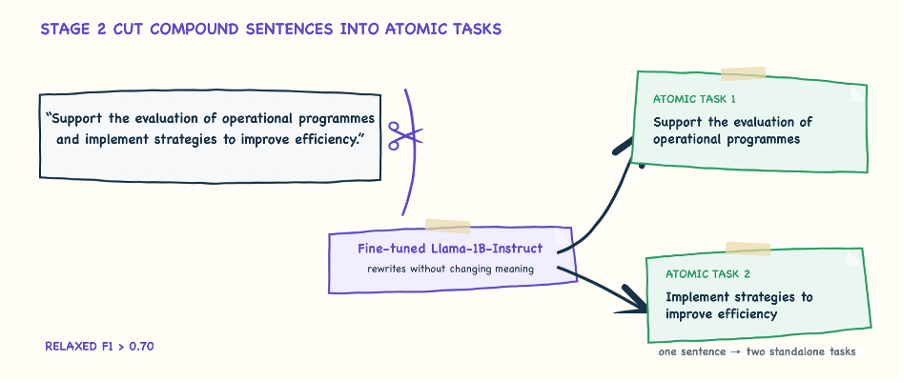
Such normalisation is important because sentence boundaries and task boundaries are not always the same. Employers frequently combine several responsibilities within one long sentence, embed them in introductory language, or describe the same work at different levels of detail. Producing atomic statements gives each task one clear analytical identity.
The fine-tuned Llama-1B-Instruct normalisation model achieved a score above 0.70 under our relaxed F1 metric.
Stage 3: Decompose each task into structured fields
A second fine-tuned small language model decomposes every normalised statement according to our task definition of action, object and optional purpose. The task “Implement strategies to improve efficiency” becomes:
- Action : Implement
- Object: Strategies
- Purpose: To improve efficiency
The result is a structured task record that can be stored, searched and analysed alongside other job-skills data.. At this point we can start discerning from thousands of differently worded job-posting statements how work is evolving.
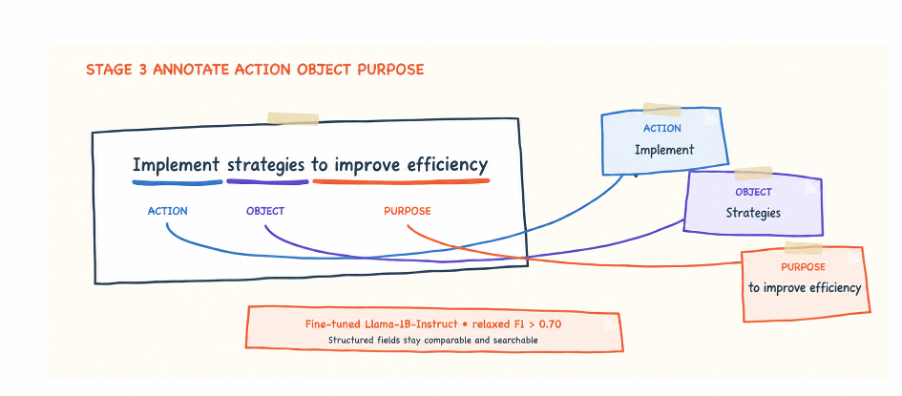
Figure 6 makes the analytical benefit concrete. Once every task follows the same schema, we can examine whether tasks share an action, concern or pursue related purposes. This supports more granular and precise comparisons than whole sentences alone.
The second fine-tuned Llama-1B-Instruct model also achieved a relaxed F1 score above 0.70 for action, object and purpose decomposition. Together, the two generative stages produced task records that were structured and consistent for database storage, and downstream analytics and surveillance use cases.
Why use focused models at each stage?
The pipeline deliberately separates detection, normalisation and decomposition. These are related problems, but they are not identical. A sentence classifier answers whether a passage contains task content. The first small language model rewrites that content into atomic statements. The second maps those statements into a defined schema.
This division of labour gives us clearer evaluation points. We can test whether the classifier selects the right sentences, whether normalisation preserves meaning without adding content, and whether decomposition assigns the correct action, object and purpose. It also lets us improve one stage without redefining the entire system.
We selected a one-billion-parameter model because latency mattered alongside extraction quality. The pipeline needs to process job postings and task records at a scale measured in the millions. A compact model helps keep processing time practical while meeting the quality threshold for normalisation and decomposition.
What we are still learning
A task extractor should not treat every sentence in a job advertisement as ground truth. Job postings describe intended work, not necessarily everything a worker does in practice. Language rules can be complex, writing can be ambiguous, and responsibilities can be aspirational, and similar tasks can be expressed at very different levels of detail.
That is why clear definitions, expert validation and ongoing evaluation matter. We need to test the pipeline stage by stage, monitor how language changes across sectors, and check that normalisation does not erase meaningful context. Precision and consistency are especially important when the output informs policy interventions, training curriculum and job redesign decisions.
Putting the task extractor into practical application for workforce action
As AI adoption becomes more prevalent within enterprises, a key consideration is how job roles can be redesigned with AI to improve productivity, while creating meaningful roles and opportunities for workforce development.
The task extractor supports this job redesign effort in an AI-enabled workplace. It turns job roles into explicit, normalised tasks that give employers a clearer view of what the role involves, and a practical basis for deciding how the work should evolve. Employers can then concretely examine which tasks should remain driven by humans, where AI can support the work, which responsibilities could be combined or reshaped, and what new tasks may need to be introduced. This will ultimately help them redesign the role around effective human-AI collaboration.
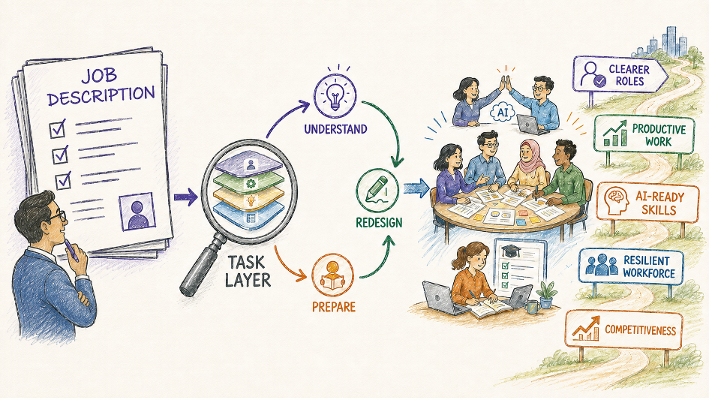
The same view helps employers prepare their people for the redesigned work. By connecting changes in the task mix to the skills required, employers can identify development needs, plan training and support mobility into adjacent work. The result can be clearer roles, better use of technology, more productive work and a workforce that is more resilient and ready for the AI era. Keeping people at the centre of that redesign also helps organisations maintain trust, accountability and competitiveness.
Moving from task extraction to task intelligence
Extraction is the foundation, not the end point.
With the Task Extractor in place, we can move to enabling analysis and insights generation at the task level. Once job posting language has been converted into consistent task records, we can study how tasks relate to one another, how employers combine them into jobs, and how those patterns change over time. This opens a new analytical layer beneath job titles and skills. The following are a few focus areas.
Core Tasks: We want to identify the tasks that form the enduring centre of a job role, and distinguish them from supporting, peripheral or newly emerging work. Tracking whether these core tasks remain stable, decline or change in character can provide a much clearer account of how a job may be potentially changing. Furthermore, understanding the impact that external disruption will have on these core tasks will provide us with a proxy for how a job could potentially become affected.
Task Bundles: Work is rarely organised as isolated tasks. Employers assemble related activities into bundles that define how a role operates in practice. Studying which tasks repeatedly appear together or need to be done in tandem, and how those bundles are being reconfigured, can reveal new hybrid roles, changing workflows and different ways of dividing work between people and AI.
Task Similarity and Adjacency: Comparing tasks through their action, object and purpose can show where work overlaps across roles. Similar tasks reveal common ground, while adjacent tasks show realistic next steps that may require only a manageable skills bridge. This gives career-transition analysis another dimension: workers can be matched not only through job titles or stated skills, but through the work they already know how to perform and the adjacent work they could move into.
Together, these measures can also provide earlier signals of potential disruption. A rapid change in a role's core tasks, the unbundling or rebundling of established work, or the growth of new AI-related tasks would not by itself prove that a job is disappearing. It would, however, indicate where closer study, employer engagement or early workforce intervention may be needed. Collectively, these remain areas where more work can be done.
This work reflects the contributions of many colleagues across the Careers, Skills and Intelligence Group (CSIG), in collaboration with the GovTech Forward Deployed Team, whose technical expertise, domain knowledge, and thoughtful feedback shaped it at every stage.